A goal tells you what you want to accomplish. A strategy explains how you intend to make it happen.
Without a strategy, a goal is little more than a wish. You have no direction, no way to measure your progress, and no basis for deciding whether you should continue, adjust, or try something different.
Strategy does not have to be complicated. It is not necessarily a five-year business plan, a mission statement, or a long document sitting in a binder that nobody reads.
Strategy is deciding where you want to go and intentionally creating the conditions that make it more likely you will get there.
Notice I said “more likely.”
Strategy does not guarantee success or eliminate uncertainty. Life does not work that way. Strategy gives you direction, helps you prepare, and gives luck somewhere to land.
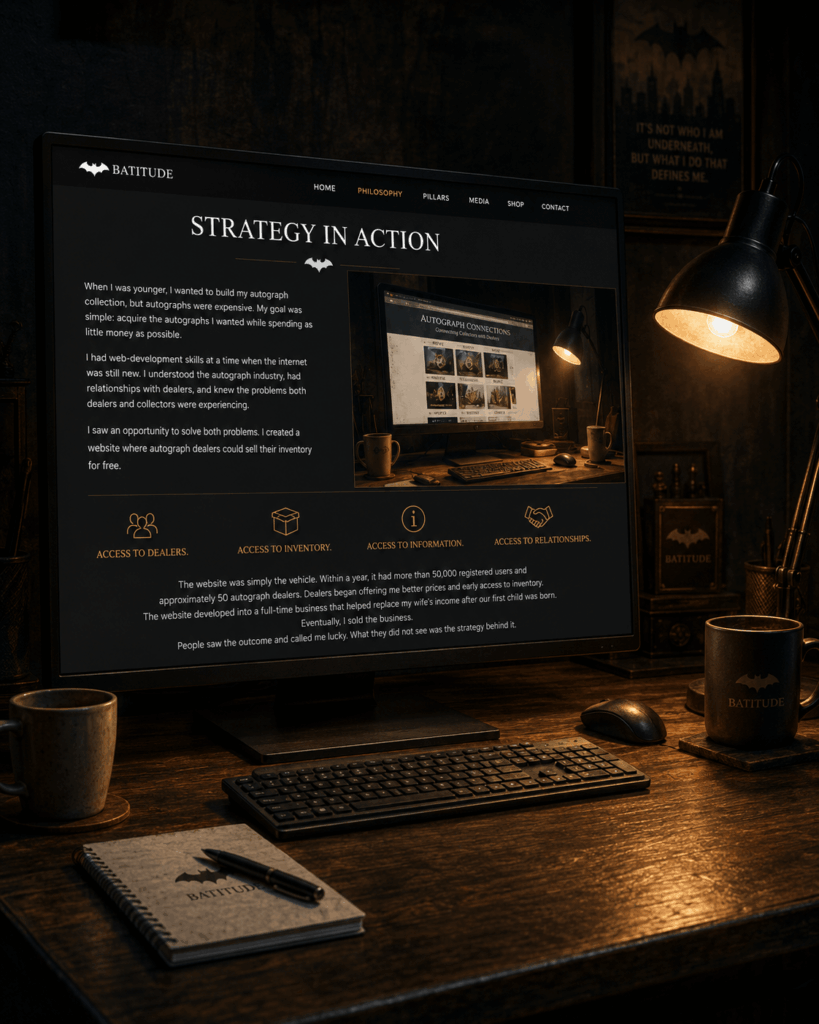
Strategy in Action
If you have read my introduction, you already know I have a bit of a Batman problem. It probably will not surprise you to learn that I also collect autographs.
When I was younger, I wanted to build my collection, but autographs were expensive. I was beginning my career and starting a family, so spending large amounts of money on collectibles was not exactly responsible.
My goal was simple: acquire the autographs I wanted while spending as little money as possible.
That may sound like wishful thinking. It was, until I developed a strategy.
I did not have a lot of money, but I had web-development skills at a time when the internet was still new. I understood the autograph industry, had relationships with dealers, and knew the problems both dealers and collectors were experiencing.
Dealers could reach customers through eBay, but the fees kept growing and the platform stood between them and their customers. Building lasting relationships was difficult. Collectors had their own frustrations finding reputable dealers and desirable inventory.
I saw an opportunity to solve both problems. I created a website where autograph dealers could sell their inventory for free. I was not trying to build the next eBay. I was creating access:
When a Strategy Stops Working
Of course, not every strategy succeeds.
Years later, I created another plan to help me buy something I had wanted since childhood: a Batmobile. I gathered several talented friends and started a business buying, restoring, and reselling cars.
Initially, the plan worked. We made money, my friends earned extra income, and I began building a Batmobile fund.
Then the assumptions behind my strategy started falling apart.
The repairs became more complicated. Tools and overhead became more expensive. My friends viewed the project as a job, while I had viewed it as friends enjoying a hobby together.
My career also advanced, making the time I spent flipping cars increasingly costly.
The hobby became work. The fun became an obligation. I was working harder, making less progress, and continuing to follow a strategy that no longer made sense.
My strategy did not fail because having a plan was a mistake. It failed because my original assumptions were wrong, and I did not adjust quickly enough when the evidence changed.